
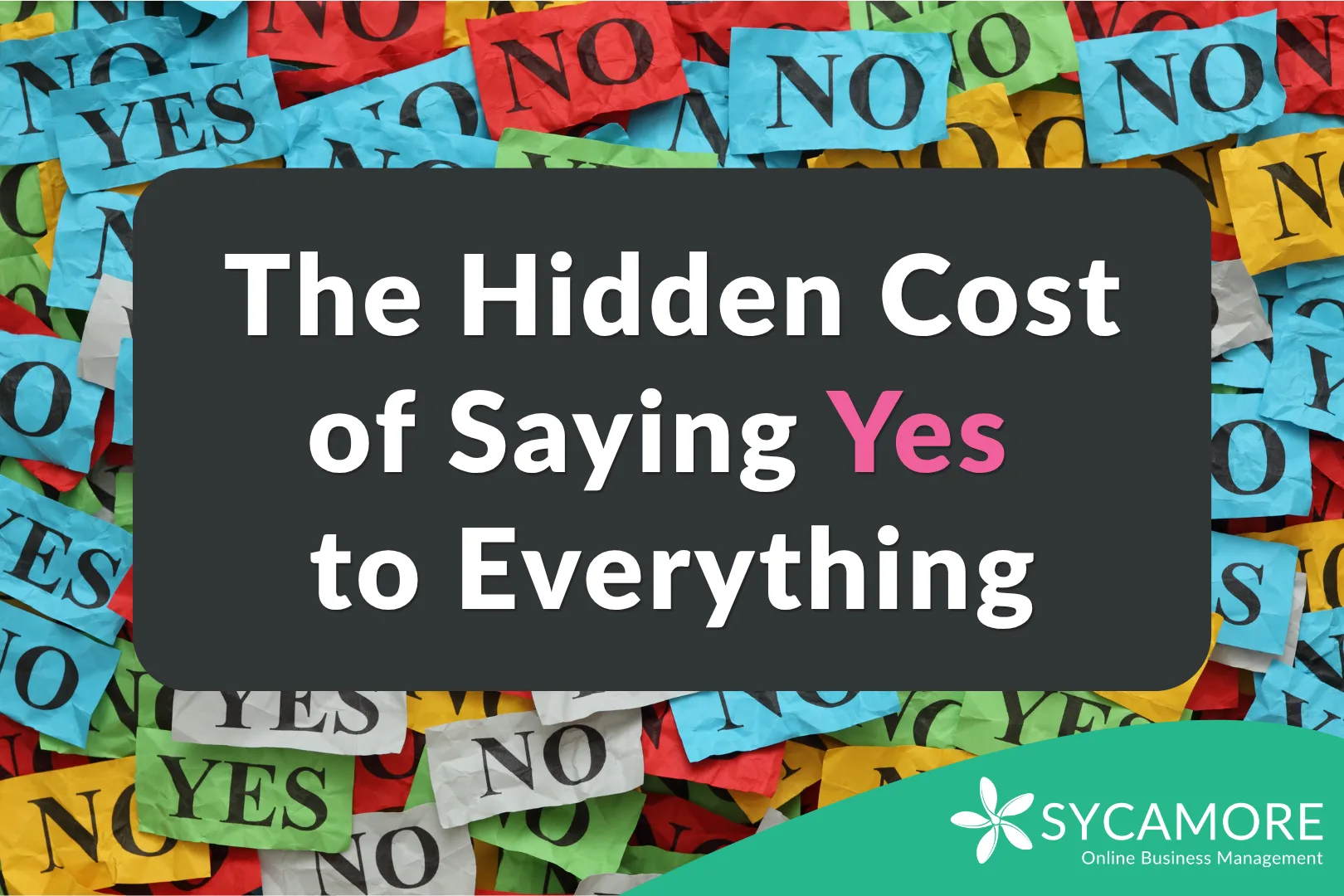
“I say yes to pretty much most things. I need to push back more.”
A client said this recently, and it sparked an interesting conversation. At first glance, it sounded like a conversation about boundaries, but the more we talked, the more we realised that wasn’t really the issue.
They weren’t saying yes because they struggled to advocate for themselves. They weren’t saying yes because they didn’t know their priorities. They were saying yes because they genuinely wanted to do the things people were being asked to do.
And I think that is often what makes saying No so difficult.
Why We Say Yes
Many business owners are naturally curious people. We enjoy learning, solving problems and helping others. When opportunities come our way, we can often see the possibilities straight away.
Perhaps someone asks us to get involved in a charity event. A friend suggests organising a family gathering. A school committee needs support. A connection has an idea for a new project. Or someone asks for help with something we know we could do it well.
These opportunities often align with our values and interests, which makes them difficult to turn down.
For neurodivergent business owners, there can be another factor at play, too. New opportunities often bring a burst of dopamine, energy and excitement. We imagine what could happen, who we could help and where it might lead. Saying yes can feel good in the moment, giving us a welcome dose of motivation and momentum.
The problem is that we tend to assess whether we want to do something before we’ve considered whether we realistically have the capacity to do it.
The Hidden Cost
The cost of saying yes is rarely obvious at the point we make the decision.
In fact, saying yes often feels positive. We feel helpful, involved, productive and optimistic. The hidden cost appears later.
It shows up when every moment feels busy. When the to-do list never seems to get shorter. When evenings and weekends become catch-up time. When the holiday you volunteered to organise suddenly becomes another project to manage. When the charity event, school commitment, family gathering and work deadline all land in the same fortnight.
None of these things are independently too hard or especially problematic to deliver. In fact, many of them are things we genuinely care about.
The challenge is that they all require time, energy and mental space.
For many neurodivergent people, the workload is often larger than it appears on paper. Alongside the visible tasks, there is the invisible work of remembering, planning, coordinating and keeping track of multiple moving parts. Even enjoyable commitments can become overwhelming when there are simply too many of them.
Sometimes the things that push us towards burnout aren’t the things we have to do. They’re the things we chose to do because they mattered to us.
” Start With No “
This conversation reminded me of something I once heard Trevor Noah talk about: Starting with “no”.
Not because we should become negative or stop helping people, but because “no” creates a pause.
The issue wasn’t that this client needed to learn how to say no. The issue was that they needed a gap between being asked and answering.
Many of us automatically start from a position of yes. Someone asks for help, and our immediate reaction is, “Of course.” Someone suggests an opportunity, and we immediately start imagining the possibilities.
The problem is that we’re evaluating whether we want to do the thing before we’ve evaluated whether we actually can.
- We haven’t looked at the calendar.
- We haven’t considered what else is happening that week.
- We haven’t thought about the mental load involved.
- We haven’t asked what might need to give in order to make space for it.
Starting with no creates space for those questions.
Before an opportunity becomes a commitment, it has to earn its way to a yes.
The answer may still be yes. Often it will be. But it becomes a deliberate yes rather than an automatic one.
Creating a Filter
The client who started this conversation found a surprisingly simple solution. They no longer allow themselves to say yes immediately.
Every request, opportunity and idea gets screened before a decision is made.
Rather than asking, “Do I want to do this?” they ask, “Do I genuinely have the capacity for this right now?”
That small shift has made a significant difference.
The answer is no longer driven by enthusiasm, guilt or excitement in the moment. It is measured against what matters most and whether there is realistically space for it.
There will always be more opportunities than we can pursue. There will always be worthwhile projects, events and causes that deserve attention.
The challenge isn’t deciding what sounds interesting. The challenge is deciding what fits.
Choosing What Matters Most
Saying no is hard, especially when you genuinely want to say yes.
But sometimes protecting your time, energy, and well-being isn’t about becoming better at saying no. Sometimes it is about creating enough space to think before you say yes.
Because every yes comes with a cost. The question is whether you’ve taken the time to understand what that cost will be before you agree.
Creating that pause won’t stop you from saying yes to the things that matter. It simply helps ensure that the yeses you give are intentional, sustainable and aligned with what matters most.
Already Said Yes to Too Much?
If you’re reading this and realising your calendar is already full and you’ve already said ‘Yes’ to more than you can handle, you’re not alone.
Many business owners don’t just need more productivity tips. They need support.
The Sycamore team can help you manage projects, streamline processes, coordinate teams and take ownership of the tasks that are consuming your time and mental bandwidth, allowing you to focus on the work only you can do.
0 Comments