
Neurodivergent business owners running their own business or working as a sole trader have accomplished something remarkable, but keeping track of tax deadlines, VAT, and Payments on Account can often feel overwhelming. This guide breaks down all the key UK financial deadlines for 2026, helping you move from last-minute stress to proactive control so you can spend more time enjoying and growing your business.
By making note of these dates now and preparing for them, you can move from reactive stress to proactive control.
Editor note – Much better than procrastinating and avoiding a deadline until the day before the submission and payment is due, then, in an anxiety-filled haze, spend 3 hours surrounded by receipts, invoices, and trying to match them all together… Not you of course, that may have just been me doing my self-assessment last year on the 30th January.
PLEASE NOTE: This list isn’t intended to be exhaustive, so even with these dates in mind, do check with your accountants. There may be additional key dates and deadlines which apply to you.
Self-Assessment Income Tax Deadlines
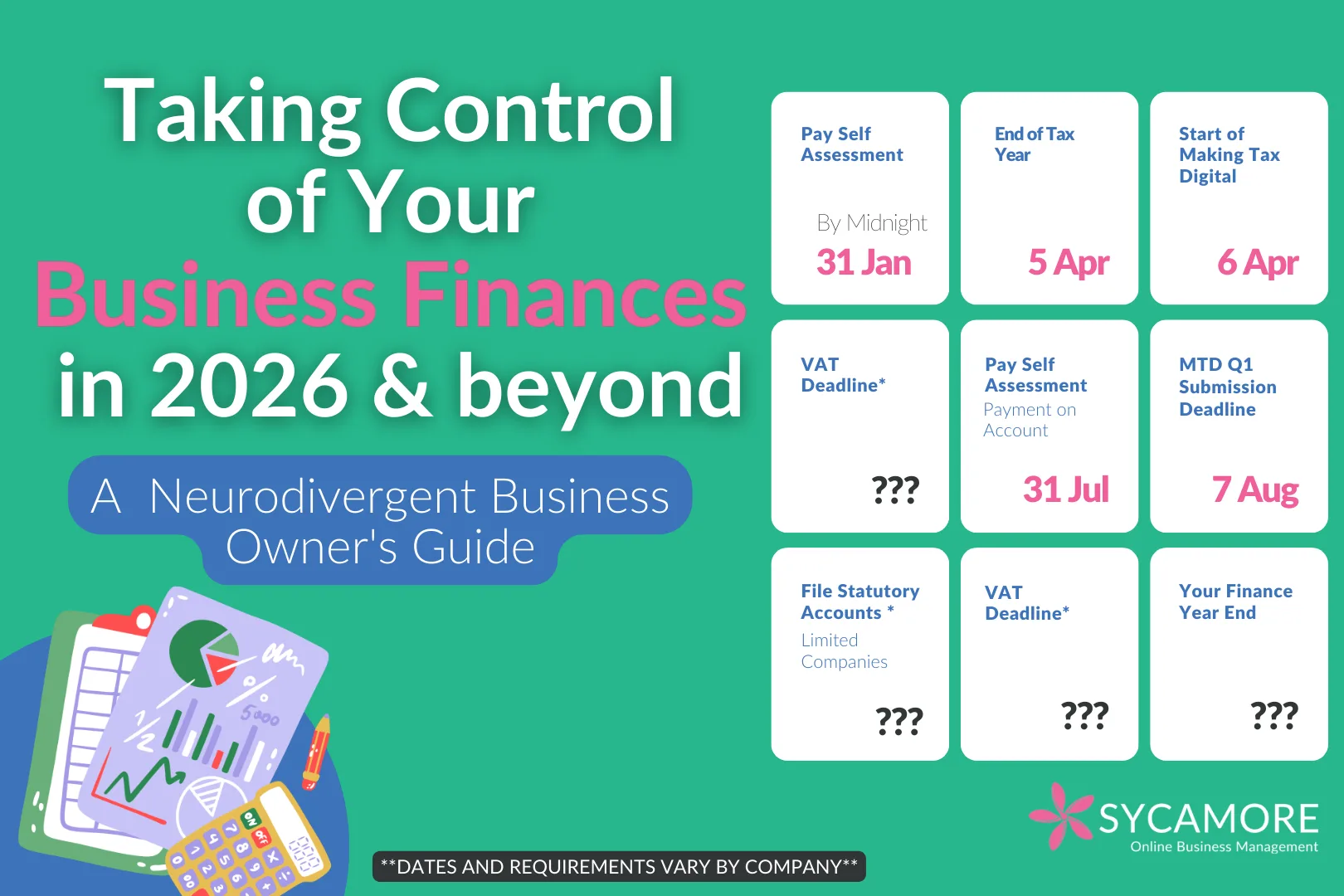
1st January 2026: Self-Assessment Submission & Payment
This is the most critical date for almost everyone who runs their own business or earns income outside of a regular PAYE job.
Sole Traders, Limited Company Directors (on dividends/other income), Landlords, Freelancers, or anyone with income not taxed via payroll will need to file a self-assessment.
The deadline is Midnight on 31 st January 2026. Every year, hundreds of thousands of people leave it to the very last day to submit their tax return, which must cause them all immense stress!
Do yourself a favour and try to do it a bit earlier so that you’ve got time to find your old bank statements and sort out any queries. You can still wait until 31st January to pay the return, even if you submit it earlier. There’s really no downside to doing it early, and you’ll save yourself the last-minute panic!
The tax return you need to complete is for the previous tax year.
So the bill is due by :
- 31st January 2026 is for 6th April 2024 to 5th April 2025.
- 31st January 2027 is for 6th April 2025 to 5th April 2026.
- and so on
By 31st January, you’ll have to have paid in full any tax you owe for that year.
And you might also have to make a “Payment on Account“, which I’ll explain later.
If you miss the 31st January deadline, there is a £100 automatic fine, even if you don’t owe any tax. Further fines and interest apply if the delay continues.
If Self Assessment applies to you and you haven’t submitted yours for 2024-2025 yet, consider this your reminder to get a move on!
Payment on Account – January & July
If your Self-Assessment tax bill is over £1,000, HMRC may ask you to pay the next year’s tax in two instalments, called “Payments on Account.” This is basically paying some of next year’s tax in advance.
- First Payment: Due on 31st January 2026 (along with your 24-25 tax bill).
- Second Payment: Due on 31st July 2026.
Payments on Account can sometimes come as an unwelcome surprise! If you can, set money aside each month in a dedicated savings account. This way, the money is ready and waiting when you need it.
Reducing Your Payments on Account
HMRC calculates your Payments on Account based on your previous year’s tax bill, which can seem a bit unfair if you know you’ll earn less this year.
If you have a clear reason to expect your taxable income to be significantly lower in the current tax year (April 25 to April 2026) than it was in the previous year, you can ask HMRC to reduce your Payments on Account.
For example, if you’ve stopped a second job, your business has scaled back, or you’ve had a large, non-recurring expense that will reduce your profit this year, you might know that you’ll pay less tax in 25-26.
You can ask HMRC to reduce your payments either online through your HMRC Self-Assessment account or by filling out and submitting a form called SA303
Important: Only reduce the payments if you are confident your tax bill will be lower. If you reduce them too much and your actual tax bill for 25-26 ends up being higher, HMRC will charge you interest and potential penalties on the underpaid amount.
Making Tax Digital (MTD) for Income Tax
Making Tax Digital (MTD) requires you to use compatible software, such as Xero, QuickBooks, and FreeAgent, to record your business transactions digitally.
If you are VAT registered, you should already be using MTD-compliant software for VAT submissions.
For sole traders, freelancers, and landlords, Making Tax Digital for Income Tax (MTD ITSA) is coming into effect. From 6 April 2026, it will apply to anyone in these groups with a total gross income over £50,000. This threshold is based on gross income, not profit and doesn’t include any salary income you earn through PAYE. You can read more on our Making Tax Digital (MTD) blog for neurodivergent entrepreneurs.
Under MTD ITSA, instead of submitting just one annual Self-Assessment, you will submit quarterly summaries of your income and expenses to HMRC using MTD-compatible software. You will also complete a final declaration by 31st January, which replaces the old annual tax return.
Preparing with MTD-Compatible Software
To get ready for MTD ITSA, start using your chosen software well before April 2026. Enter your income and expenses digitally as they occur to avoid a backlog.
This preparation helps you:
- Track your finances more accurately
- Submit quarterly summaries on time
- Reduce stress around the final declaration
Popular options include Xero, QuickBooks, and FreeAgent, all of which are MTD-compliant. Choose one that fits your workflow and stick with it to make quarterly submissions straightforward.
Quarterly Submission Deadlines
The MTD submission deadlines for this year are as follows:
- 6th April to 5th July 26: Submission deadline 7th August 26
- 6th July 26 to 5th October 26: Submission deadline 7th November 26
- 6th October to 5th January 27: Submission deadline 7th February 27
- 6th January to 5th April 27: Submission deadline 7th May 27.
The first final declaration for the tax year 26-27 will be due on 31st January 2028.
If your business or property income is over £50,000 (and you’re not already doing MTD for VAT), start speaking to your accountant or bookkeeper about MTD software before April 2026.
VAT Deadlines for UK Businesses
If your business is VAT registered, you must submit a VAT Return every quarter. The deadline for filing your return and paying any VAT due is one calendar month and seven days after the end of your VAT period.
Understanding Your VAT Quarter
For example, if your VAT quarter runs from 1st October 2025 to 31st December 2025, the deadline for submission and payment is 7th February 2026. Your specific quarterly dates may differ depending on your VAT cycle, so check your HMRC online account and add one month and seven days to each quarter for deadlines.
Preparing and Managing VAT Payments
To avoid stress, if you can, it is helpful to set aside money each month in a dedicated account so the VAT you owe is ready when you need it. This habit prevents last-minute scrambling and helps you stay organised.
VAT Registration Threshold
The current threshold to register for VAT is a turnover of £90,000 over a 12-month rolling period. If you exceed this, make sure you register for VAT, and your accounting system and processes are prepared to manage quarterly VAT submissions efficiently
Limited Company Tax and Compliance Deadlines
If you run a Limited Company, your deadlines are specific to your business. The most important date to know is your Company Year End.
If you need a reminder, you can look it up on the Companies House website
Under the Accounts header, look for “Next accounts made up to…” and the date will be your year-end.
Key Deadlines
There are three deadlines you need to be aware of:
- 9 months after your year-end: File your Statutory Accounts with Companies House
- 9 months and 1 day after your year-end: Pay your Corporation Tax
- 12 months after your year-end: Submit your Corporation Tax return
Using an example, if your year-end is 31st December 2025:
- 30th September 2026: Statutory Accounts
- 1st October 2026: Pay Corporation Tax
- 31st December 2026: File Corporation Tax Return (although this will likely be done earlier and at the same time as you pay the tax)
Yes, it is odd that you have to pay your Corporation Tax bill before you officially have to submit your Corporation Tax Return. In practice, most accountants file the return 9 months after the year-end and pay the bill at the same time.
Other Important Financial Dates for Your Calendar
- 5th April 2026: End of the 25-26 tax year.
- 6th April 2026: Start of the New 26-27 tax year. All the new tax allowances and rates for the 26-27 year begin.
- 31st May 2026: If you run a Limited Company and pay yourself (or employees) via PAYE, you must give every employee/director a P60 by this date.
- 6th July 2026: Deadline to report certain employee expenses and benefits (like private health insurance) to HMRC on a P11D form.
Your Finance Support System
You do not need to memorise all these dates if you have a reliable system in place to make sure nothing is missed.
Use Digital Reminders
Add all the important dates for your business to an online calendar and set multiple reminders for each one, including a countdown if possible. Even if you tend to ignore pop-ups until the last minute, seeing the deadlines repeatedly will help you stay on track and avoid last-minute stress.
Talk to Your Accountant
Clarify which dates and submissions are their responsibility and which are yours. Different accountants have different fee structures, and some may not handle all submissions for you.
This is especially important if you will be using Making Tax Digital (MTD) this year.
Work with a Sycamore Online Business Manager
A Sycamore Online Business Manager can help plot key dates in your calendar, organise your records, and help you plan ahead. With our support, you can stay on top of deadlines and avoid last-minute panics.
If keeping track of deadlines feels overwhelming, a Sycamore OBM can help set up a clear, simple finance support system tailored to your business. This allows you to focus on running your business with confidence, knowing your finances are organised and under control.
Book a free 30-minute call with Holly Davies to see how Sycamore OBM can support you and match with the Sycamore team member who best fits your working style.

0 Comments