
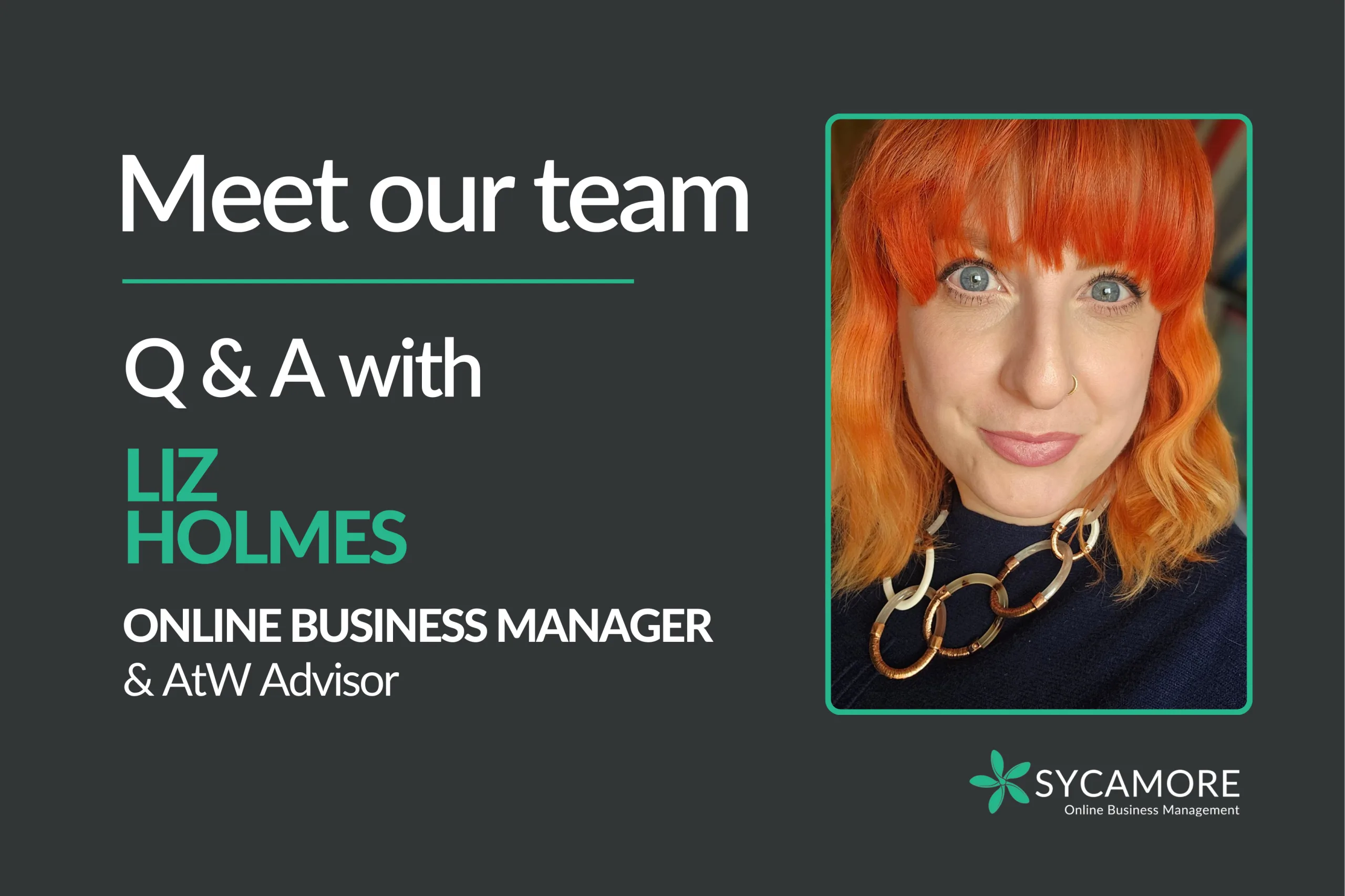
Not all heroes wear capes. Some write brilliant systems docs, send expertly crafted emails, and keep a business running like clockwork behind the scenes.
This month in our Meet the OBM series, we’re catching up with Liz Holmes, Sycamore Online Business Manager and Advisor to Sycamore’s AtW (Access to Work) clients, whose journey from arts admin to online business support is as inspiring as it is relatable.
Liz brings a wealth of experience in operations, a deep understanding of neurodivergent needs, and a talent for getting things done (with just the right amount of sass). In this Q&A, she shares how her background shapes her approach to supporting clients, “spiky profiles”, and which AI tool she swears by for getting stuff done.
Tell us a bit about your work history and how you came to be an OBM at Sycamore
I worked in the arts industry for 20+ years, always in admin/operations, managing performances, buildings, unions, all sorts. But with a lot of neurodiversity in my inner circle, my caring needs changed. My life was no longer compatible with the theatre lifestyle and I found myself feeling very distanced from an industry my family couldn’t access much of and that I found increasingly inauthentic. I’d also been running a national charity I was passionate about and wanted to do more ‘good’. I was sort of half-heartedly looking at freelance opportunities when I came across an ad from Sycamore, and it really spoke to exactly where I was at that time.
What do you love most about your role at Sycamore OBM?
Massively varied workload, from lovely, pastoral, caring support-type roles, right through to strategic business development stuff. I’ve also got stuck right in with some of the heavier, policy, governmental, advocacy-level grit too, supporting loooooads of people through the Access to Work application, assessment and awards process (warts and all).
I get to have a really broad overview of my clients’ work. They’re all incredible, creative, innovative people, who are a pleasure to work with.
I love that Sycamore doesn’t separate personal and professional life. Our approach is more holistic and person-centred, nuanced, and the team is amazing. I’m the most honest with my colleagues, my clients (and, importantly, myself) than I have ever been in any other job. Our team meeting every Tuesday is an absolute highlight of my week.
What are your favourite types of tasks or projects to get stuck into?
I love, and this is probably not something that most would care to admit, the day-to-day operational chug of supporting a business. Just keeping things functioning smoothly, effectively and efficiently. Of course, I like creating systems, and strategising, but I feel like I really thrive at just getting sh*t done 😉
I’m a do-er and a fixer. Not so much an innovator, I’ll leave that to my clients! I also love a strongly worded email. If you need a strongly worded email, I’m your gal.
Are you neurodivergent yourself, or do you have close personal experience with neurodiversity?
Very good question. I have no formal diagnoses, but my brain is definitely not typical! I live with chronic migraine, which has resulted in my brain being a bit damaged over the years, so I experience many of the same challenges with fatigue, social battery, sensory overload etc, as neurodivergent folks. My son is autistic, my husband is AuDHD, and there’s clear neurodivergence in my wider family, and a lot of my closest friends. I strongly believe we love the people we love for a reason, and that we’re drawn to, and communicate best with people whose neurology complements our own. Make of that what you will. I think I’m probably one of the lost generations of women with ADHD who would fall short of diagnostic criteria. I’ve mainly fought (and I mean FOUGHT, it got ugly) for my son’s rights, so really got stuck into neurodiversity advocacy through him, volunteered on our local Parent Carer Forum, took SEND Law training etc.
How has your neurodivergence shaped how you work?
Infinite understanding and belief that people are the experts in their own experience. I don’t pay much attention to scholars and consultants, I only really want to hear from neurodivergent folks themselves. Unquestioning acceptance that when someone tells me they find something challenging, they find it challenging, and then we can work out ways around it. I am not about enabling people to assimilate into neurotypical culture, take on neurotypical ‘out-of-the-box’ solutions. I can’t be doing with inauthenticity.
What’s one thing you wish more people understood about working with neurodivergent business owners?
Spiky profiles! What is achievable one day might be impossible the next.
What’s your favourite tool, app or system for getting stuff done?
I’ve been loving Notion. It’s very customisable, very intuitive once you’ve watched a few YouTube videos, and can really be a one-stop shop for business operations.
Have a read of our blog about Notion and the potential benefits for small businesses, we well as some of our favourite starter templates here – Sycamore Notion Blog
When you’re not working, what do you enjoy doing to relax or recharge?
I sing in about a million choirs and play cello in an orchestra. Lots and lots of gigs and music. I can’t function without them.
Other than that, pottering in the garden, making it up as I go along, mosaicing, gymming, walking the dog. Life.
What’s your current hyperfocus, obsession or interest outside of work?
Smutty romantasy novels and associated fan-art, OBVIOUSLY. Who doesn’t have a favourite wyvern?
Also painting anthropomorphised animal skirmish bands for table-top gaming. Currently working on a fox assassin.
What’s your best tip for someone trying to build a business that works with their brain, not against it?
Honesty. Authenticity. Don’t hold back on what you’re good at, and be open about what you find challenging. That can be really difficult to do if you don’t know the environment/person you’re working with is ‘safe’. A lot of neurodivergent adults are incredibly high-masking (i.e. you don’t know how hard they work to appear functional and ‘typical’), and it’s also just general presenteeism gross work culture that we all have instilled into our brains at a young age, to put up and shut up. That leads to burnout and poor mental health.
Finding someone who’ll support you to be authentic in your work is crucial. I strongly advise doing your research and meeting a lot of people before deciding who to work with, to ensure you can be as authentic as possible.
What’s one word you’d use to describe working at Sycamore?
Liberating
From backstage to business ops, Liz brings quiet brilliance and real impact to every client she supports. We’re so very lucky to have her in our Sycamore team.
Want to get to know more of the wonderful humans behind the work?
You can meet the full team here, and we’ll be back next month with another OBM Q&A.
Until then, if you’re out there juggling all the plates, We see you.
And we’ve got you.
0 Comments