
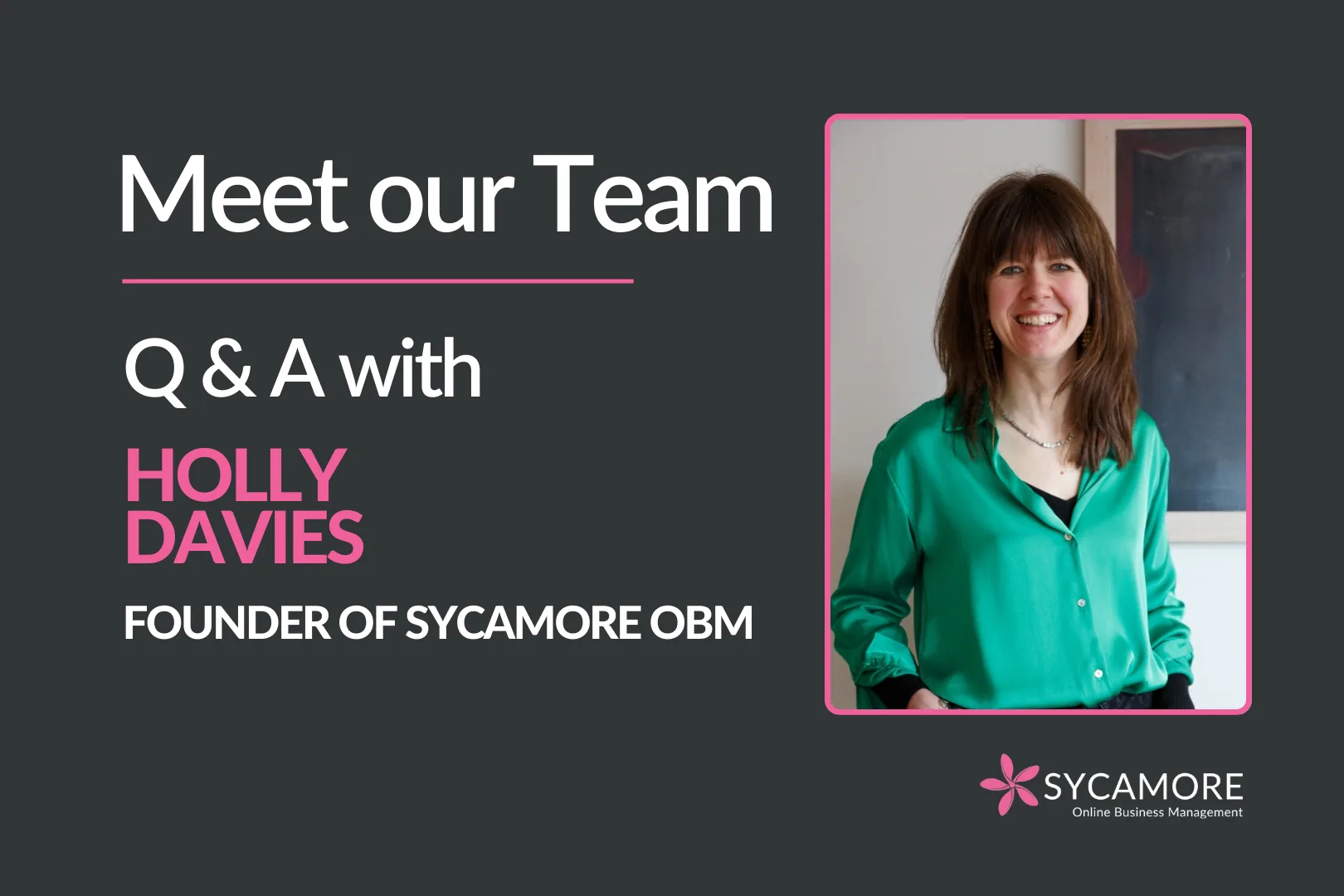
Every great business has an origin story, and Sycamore’s begins with Holly swapping years of charity fundraising for the bold leap into building something of her own. What started in 2021 as helping a handful of clients with the things they found toughest quickly grew into something bigger — a business rooted in neuroaffirming support and a community of clients who think (and work) differently.
This month in our Meet the OBM series, we’re catching up with Holly Davies, Sycamore’s founder, who still swears by spreadsheets, never underestimates the power of curiosity, and believes that business should work with your brain, not against it.
Holly shares how her own dyslexia has shaped her outlook, what she loves most about leading the team, and why running with a good podcast (and winding down later with wine, chocolate, and a book) are her favourite ways to recharge. More than anything, she’s passionate about seeing neurodivergent business owners thrive — and hopes Sycamore can be part of that journey.
Tell us a bit about your work history and how you came to start Sycamore
I set Sycamore up in October ‘21. I’d been a charity fundraiser for a long, long time, and I wanted to create my own business, so I could do things in the way that I wanted to do them. I started helping a small number of clients with things they were struggling with. 6 months later, I realised that nearly all my clients were neurodivergent and there was a synergy between what I could offer and what they needed. That neurodivergent niche was key for Sycamore; it helped us identify our target audience and how we were going to move forward.
What do you love most about your role at Sycamore OBM?
This is an easy one, seeing what the team achieve for our clients. This could be anything from saving people thousands of pounds in costs, to getting clear on their business goals, to delivering virtual products for clients. And the team deliver all of this in a neuroaffirming way.
How could someone not love that!
What are your favourite types of tasks or projects to get stuck into?
Spreadsheets are my happy place. I also enjoy supporting the team to navigate challenges as and when they come up.
Are you neurodivergent yourself, or do you have close personal experience with neurodiversity?
When I was younger, teachers told my parents they thought I would be a clever student, but then “they realised I was stupid”. This prompted my parents to seek a dyslexia diagnosis.
Thankfully, Grammarly exists, so my spelling is no longer an issue for my typing, so no extra spelling lessons for me anymore. Happily, my family help out with the kids’ spelling practice to save me from revisiting that horror! But each time I do a supermarket order, I wish I could say the words instead of having to type them – I find spellings for food particularly challenging.
I struggle to spot any mistakes in a piece of written work if I read it through. I often use Natural Readers, a free text-to-speech programme that reads my typed written work out loud. I find this really helpful as it allows me to listen to a voice reading my work, and helps me spot any mistakes.
How has your neurodivergence shaped how you work?
I am always learning about others’ experiences of their neurodivergence. It’s a really powerful part of our work. I learn from the team here at Sycamore and our clients. It’s helped me understand that I always want to be coming from a position of understanding and curiosity. That curiosity piece comes directly from a client. It’s her byword and I find it really useful.
What’s one thing you wish more people understood about working with neurodivergent business owners?
My experience shows that neurodivergent business owners work incredibly hard to make the world a better place, one step at a time. That is something that should be celebrated, supported and encouraged.
What’s your favourite tool, app or system for getting stuff done?
My brain loves ticking things off on a simple Excel/sheet or a good old to-do list.
I’m a simple girl at heart.
When you’re not working, what do you enjoy doing to relax or recharge?
Running while listening to podcasts is massively helpful for my mental health; it gives me far greater resilience on that day to deal with what life will throw at me.
At the end of the day, red wine, chocolate and a good book are hard to beat.
What’s your current hyperfocus, obsession or interest outside of work?
I struggle with interior design. I can be creative, but knowing what will look good in a room is hard for me. But it gives me real joy when I feel a room looks like it has been put together well. So I’m learning to take it slow and get many, many samples of things before deciding which bits are going to look good in that room.
My daughter told me the other day that she now loves her room, I was smiling so much.
What’s your best tip for someone trying to build a business that works with their brain, not against it?
Be kind to yourself. Know that good things take time. Each day is different, do what you can do on any given day and don’t beat yourself up about not achieving more in a timeframe. Don’t compare yourself to others, particularly on social media.
Lastly (of course) – outsource anything to Sycamore that doesn’t play to your skill set. You should be spending your time doing what only you can do, which is normally delivering for customers or finding the next customer. The way to do more of that is to outsource anything that doesn’t have to be done by you. You can book a call with me here to talk about what Sycamore could do to free you up.
What’s one word you’d use to describe working at Sycamore?
One word, that’s hard. It would have to be “rewarding”.
Want to get to know more of the wonderful humans behind the work?
You can meet the full team here, and we’ll be back next month with another Sycamore Team Q&A.

0 Comments