
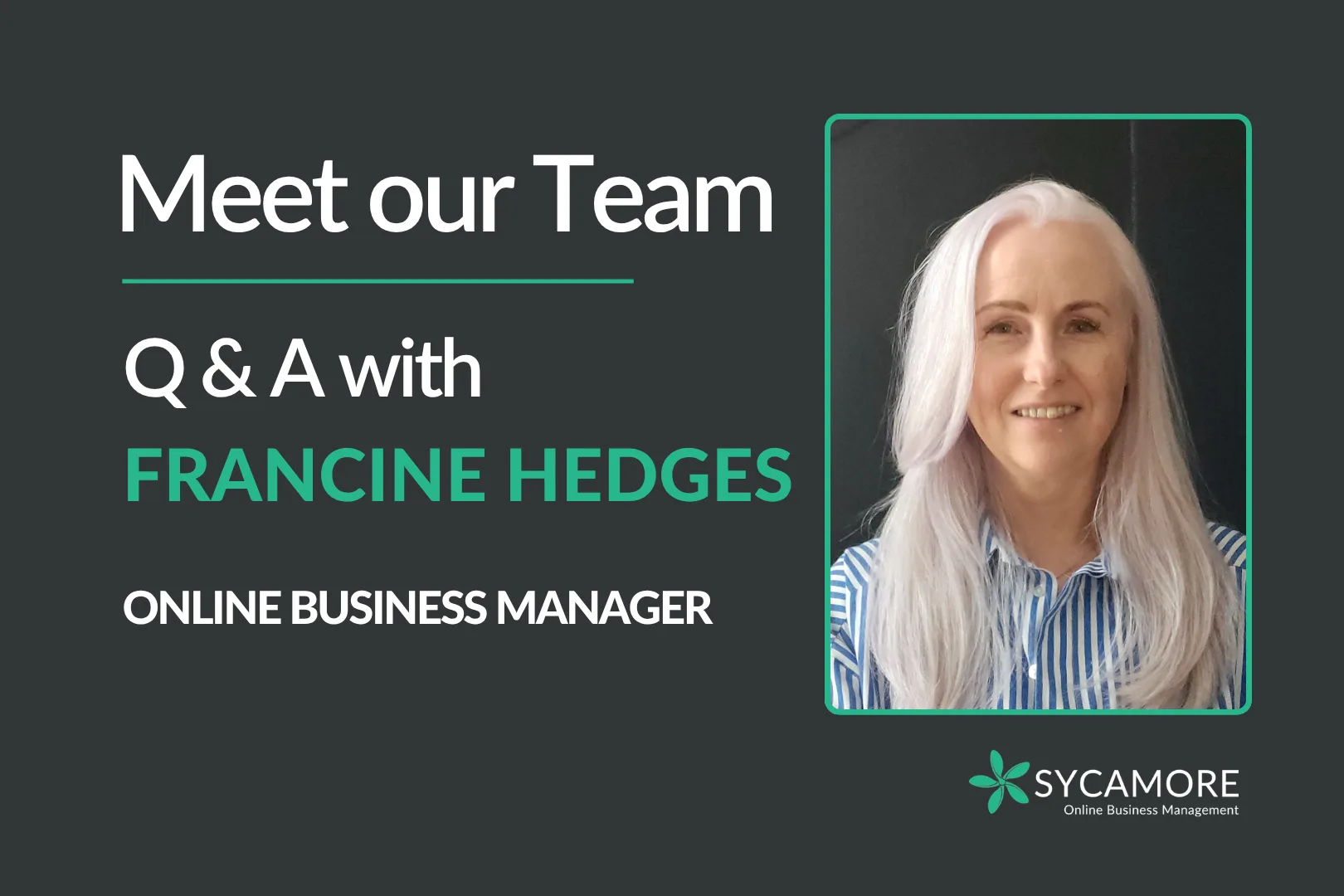
With over 20 years of self-employed experience, Francine has built businesses, supported others to do the same, and learned first-hand how to navigate the inevitable hurdles along the way. If something needed solving, she figured it out. If growth required new skills, she learned them. That mix of resilience, curiosity, and practical know-how now underpins the methodical approach she brings to her clients at Sycamore.
Francine is at her best when she’s getting to the heart of a problem, asking the right questions, and unlocking that “this is it” moment. She takes the big picture her clients hold and turns it into something clear, structured, and actually doable, helping remove the blocks that keep people stuck and freeing them up to focus on what they do best.
In this Meet the OBM Q&A, Francine shares her journey into the role, what she loves most about supporting business owners, and why letting go of the things that drain you might be one of the smartest moves you can make, especially for neurodivergent entrepreneurs.
Whether you’re wondering what an OBM really does, thinking about getting support, or just enjoy seeing how the magic happens behind the scenes, you’re in the right place.
Tell us a bit about your work history and how you came to be an OBM at Sycamore
I’ve been self-employed for over 20 years now, starting and running businesses of my own whilst helping others start and run theirs. For 20 years, if I met a hurdle, I figured out how to overcome it. If I needed to get to another level, I learned a new skill. Over time, I developed methodologies and a wide knowledge base. I genuinely enjoy helping other business people, and this is what led me to Sycamore.
What do you love most about your role at Sycamore OBM?
I really love delving into the heart of any given situation, asking the right questions to discover that “Ah! This is how we solve it!” moment and then being the person to make it better, more efficient or more successful. That beautiful “big picture” my client has; that’s where my methodical approach can help bring it to life.
What are your favourite types of tasks or projects to get stuck into?
My favourite tasks are those where what I can do actually gives the client clarity. I often find that what I’m good at is a stumbling block for my clients, and this is what I love to do: to help free them up so that they can move forward and succeed.
How has your understanding of neurodivergence shaped how you work?
I am continually impressed by the sheer creativity of people with any form of neurodivergence – and that despite any challenges they might face along the way, they continue to drive themselves onto success.
What’s one thing you wish more people understood about working with neurodivergent business owners?
I find that for some neurodivergent entrepreneurs, there are certain tasks that can be a real mental barrier to running a business, and I wish more people in that position would recognise that no one person is great at everything; that it’s perfectly ok to delegate or outsource.
The relief on your mental load is worth admitting that you aren’t superhuman. In fact, outsourcing tasks is a sound strategy for business success.
Do you have a favourite tool, app or system for getting stuff done?
That’s a tough one. AI models like Claude are impressive tools when you know how to interact with them effectively. Google Workspace can be excellent if you have a small team and want to centralise assets and knowledge.
Also, I love Airtable – if you need an excel spreadsheet but it needs to do a bit more and look a little better – that’s your solution!
When you’re not working, what do you enjoy doing to relax or recharge?
I love good food and a great bottle of wine! I hate cooking, but I married a man who’s great at it and enjoys it too! We’re renovating at the moment, so I’m claiming that as exercise, and I’ve been flexing my green fingers this year, to see what I’m capable of keeping alive in the garden!
What’s your current hyperfocus, obsession or interest outside of work?
I love to read, but I can lose myself in a great novel, and before I know it a week has passed, so I steel myself to only do this when I have time off. I’ve been trying to read more non-fiction for the last year or two: mainly biographies of leaders through the ages and people who have made a difference in the world.
What’s your best tip for someone trying to build a business that works with their brain, not against it?
Accept that your amazing skillset is your most valuable tool. Don’t waste your time on admin or tasks you hate or things that bore you to tears, as these will become a barrier to your success.
Trusting other people to help you can be hard, but worthwhile.
What’s one word you’d use to describe working at Sycamore?
Inspiring
Want to get to know more of the wonderful humans behind the work?
You can meet the full team here, and we’ll be back next month with another OBM Q&A.

0 Comments