

It’s not uncommon to feel a drop in mood or energy levels on the descent into winter, and it’s estimated that up to 5% of people in the UK will develop Seasonal Affective Disorder, which can be experienced in any season, but is most prevalent in winter.
We keep trucking, plugging away at our work and family lives, while leaves wither and fall, and animals lay down fat stores for hibernation, brumation or torpor. It is exceedingly tempting to embrace our inner badger or hedgehog and take to bed with a great many snacks, but that’s not particularly good for business!
The Neurodivergent Winter Struggle Explained
Neurodivergent people face a host of challenges across the colder months. Reduced sunlight affects the function of the hypothalamus, which can disrupt the production of serotonin – the hormone that regulates mood, appetite and sleep. Given that many neurodivergent people experience chronic depression, a further decrease in serotonin over winter can make it seem a bleak and relentless slog. Darkness also, rather unhelpfully, increases the production of melatonin. For the many ND people who already experience sleep disruption and issues with regulating circadian rhythms, shorter days dysregulate, leaving you sleepier and more lethargic and sluggish than usual – again, not super-duper for trying to grow your business and maintain working processes.
Seasonal shifts can be challenging in and of themselves for those who find change and transitions difficult, and winter can be a sensory nightmare. Those amongst us who cannot tolerate cold and wet conditions, increased lighting in public spaces, and the many festivals, religious holidays, social activities and gift traditions across the season.
We often experience reduced immunity and forced proximity in cold weather, which means an increase in coughs, colds, and other lurgies, which can be hugely challenging in sensory terms. Neurodivergence sometimes comes hand in hand with other chronic conditions, with many people experiencing flare-ups in pain and fatigue with seasonal change, so we may feel as low physically as we do mentally.
Finances are also affected – you may struggle with impulse control in the season of over-consumption, you may want to hibernate, or require time away from work to deal with all of the above, so your income reduces along with your workload.
So what can you do to ease the transition?
At Work
Find comfort in the cosy, non-taxing-but-essential tasks that get sidelined in favour of more exciting or urgent work:
- File your receipts
- Gather testimonials from clients that tell everyone how amazing you are
- Play with colour palettes and design for your social media, print or websites
- Blog or journal
- Get in touch with your favourite clients you’ve not worked with in ages
- Remember – what’s below the screen doesn’t count. Business from the chest upwards, heated blanket and pyjamas underneath.
Socially
(which can also be work, too, of course!)
- Schedule preparation time before, and recovery time after interactions, meetings, and events
- Schedule the times/places/people where it’s safe for you to ‘unmask’
- Reduce expectations and set boundaries.
- Check the Sycamore blog on Surviving Christmas Parties (applies to other festivities too)
Your Wellbeing
- Create a sensory ‘safe-space’ in your home/office with comfort/stim items
- Curate a sensory-friendly wardrobe, invest in waterproofs, wellies and thermals
- Get outdoors, if you’re able, to see daylight, and regulate those circadian rhythms
- If the outdoors is a nope, investigate daylight lamps and blackout blinds to create your own night and day
- Consider talking therapies and peer support – you won’t be alone in struggling
- Try to keep to a consistent sleep routine; this can be particularly difficult when dark mornings and freezing evenings disrupt sleep.
- Take time out to indulge your cosiest hobbies and special interests
- Heated things – all the heat-pads, blankets, hand-warmers and slippers you can lay your hands on!
Most of all, give yourself a break. Slowing down for winter isn’t a sign of weakness or inability to cope. It is a physiological state of being that pretty much everything in nature obeys, except us humans. I share THIS facebook post with friends every winter as a reminder to them, but most of all to me.
Go easy. Go gently. Spring will come.
For any non-social media people, this is the lovely post Liz shares above.
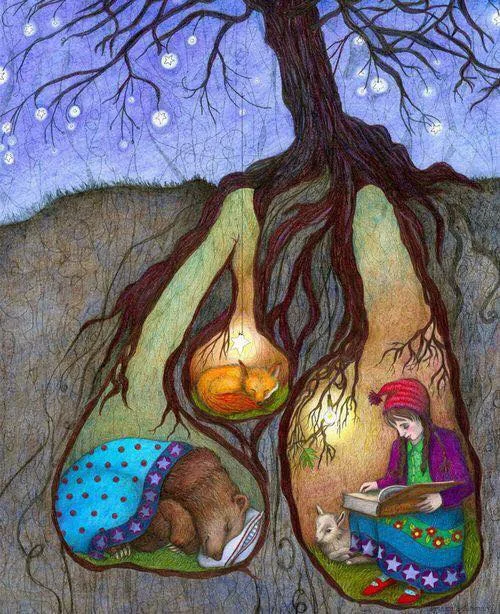
Illustration by Jessica Boehman
Words Brigit Anna McNeill
We are approaching the threshold of winter.
Life is being drawn into the earth, painlessly descending down into the very heart of herself.
And we as natural human animals are being called to do the same, the pull to descend into our bodies, into sleep, darkness and the depths of our own inner caves continually tugging at our marrow.
But many find the descent into their own body a scary thing indeed, fearing the unmet emotions and past events that they have stored in the dark caves inside themselves, not wanting to face what they have so carefully and unkindly avoided.
This winter solstice time is no longer celebrated as it once was, with the understanding that this period of descent into our own darkness was so necessary in order to find our light. That true freedom comes from accepting with forgiveness and love what we have been through and vanquishing the hold it has on us, bringing the golden treasure back from the cave of our darker depths.
This is a time of rest and deep reflection, a time to wipe the slate clean as it were and clear out the old so you can walk into spring feeling ready to grow and skip without a dusty mountain on your back & chains around your ankles tied to the caves in your soul.
A time for the medicine of story, of fire, of nourishment and love.
A period of reconnecting, relearning & reclaiming of what this time means brings winter back to a time of kindness, love, rebirth, peace and unburdening instead of a time of dread, fear, depression and avoidance.
This modern culture teaches avoidance at a max at this time; alcohol, lights, shopping, overworking, over spending, bad food and consumerism.
And yet the natural tug to go inwards as nearly all creatures are doing is strong and people are left feeling as if there is something wrong with them, that winter is cruel and leaves them feeling abandoned and afraid. Whereas in actual fact winter is so kind, yes she points us in her quiet soft way towards our inner self, towards the darkness and potential death of what we were, but this journey if held with care is essential.
She is like a strong teacher that asks you to awaken your inner loving elder or therapist, holding yourself with awareness of forgiveness and allowing yourself to grieve, to cry, rage, laugh, & face what we need to face in order to be freed from the jagged bonds we wrapped around our hearts, in order to reach a place of healing & light without going into overwhelm.
Winter takes away the distractions, the noise and presents us with the perfect time to rest and withdraw into a womb like love, bringing fire & light to our hearth.



0 Comments