
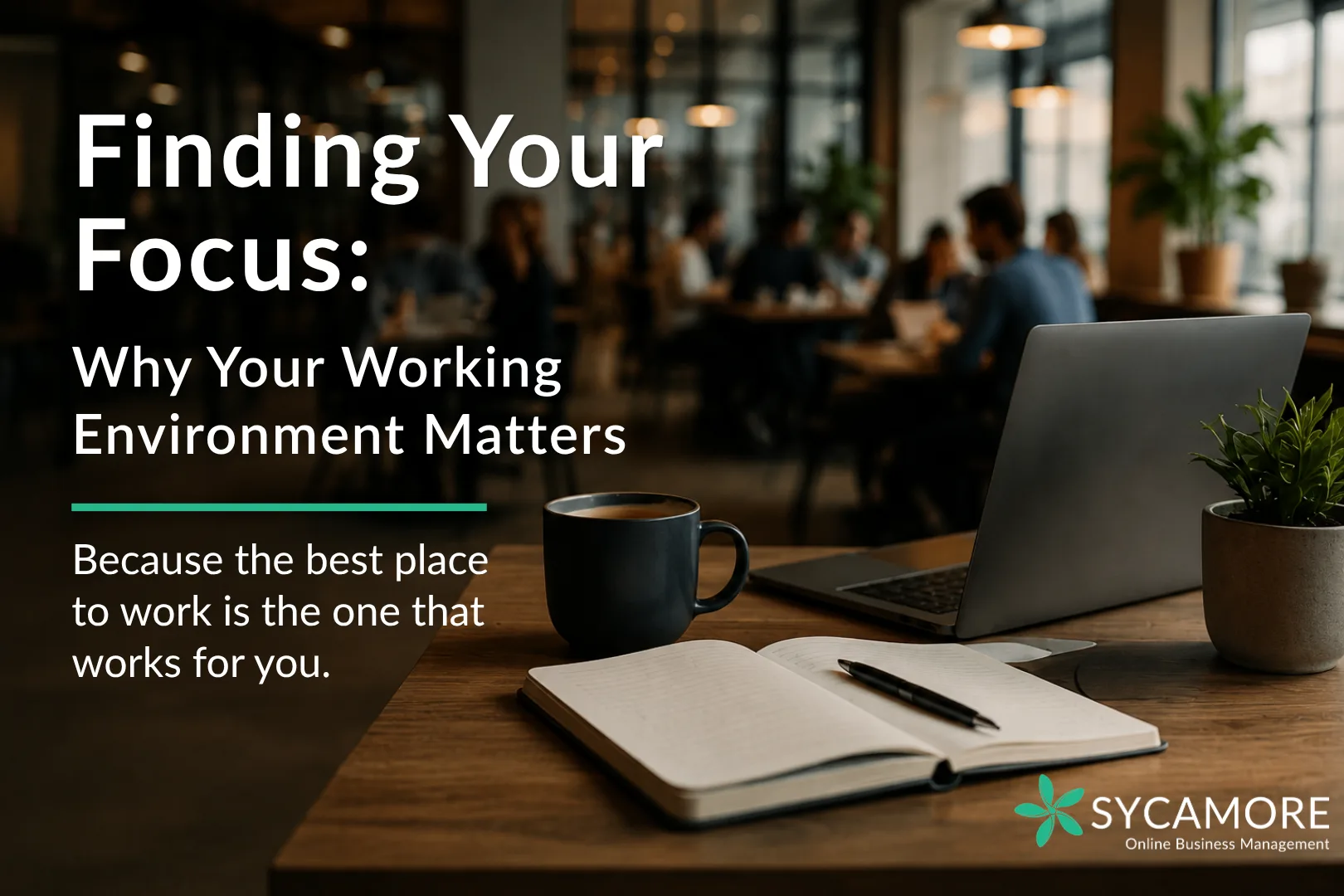
I once sat in an office trying to read through an important document while the radio played quietly in the background.
It seemed harmless enough. The volume wasn’t particularly loud, nobody else appeared bothered by it, and yet I found myself reading the same paragraph over and over again. Instead of concentrating on the words in front of me, I was mentally singing along to every song that came on.
The music wasn’t background noise for me. It had become the main event.
For my colleague in the office, it helped her focus.
In many ways, a busy open-plan office can feel like the opposite problem. Another colleague worked in that kind of environment and found the constant chatter around her exhausting. Every conversation pulled her attention away from what she was working on. She didn’t want to join in, but her brain kept tuning in anyway.
Neither of us was wrong. We simply needed different environments to do our best work.
There Is No Perfect Working Environment
We’re often told that productivity happens in quiet offices, organised desks and distraction-free spaces.
For some people, that’s true.
For others, complete silence can feel uncomfortable, distracting or even draining.
Some people focus best with music playing. Others need white noise, nature sounds, or the gentle hum of a coffee shop. Some thrive in a busy co-working space where other people are working nearby, even if they’re all focused on completely different tasks. There are days when a shared workspace feels just right. The conversations around you aren’t relevant, nobody is asking you questions, and the steady hum of activity creates an environment where work seems to flow. Other times, sitting alongside other people in a co-working session can provide exactly the accountability and energy you need to get started.
The key is understanding that there isn’t one “correct” way to work.
Different Tasks Need Different Working Environments
I’ve also noticed that what works for one task doesn’t necessarily work for another. I can happily work with music playing when I’m working with numbers, spreadsheets or routine admin tasks.
Ask me to write, edit, learn or read something carefully, and that’s a completely different story. Suddenly, the lyrics are competing with the words I’m trying to process, and I am singing along in my head instead.
Many people find the same thing. Certain types of work require different levels of attention, concentration and mental energy. The working environment that helps you complete your bookkeeping might be entirely different from the environment that helps you write a proposal, create content or learn something new.
And that is ok!
Your Working Environment Needs Can Change Too
The environment that works for you today might not be the environment that works for you tomorrow.
Sometimes we assume that once we’ve found our “ideal” way of working, we should stick to it.
In reality, our needs often change depending on:
- The task we’re doing
- Our energy levels
- The time of day
- How much sleep we’ve had
- Our stress levels
- What’s happening around us
- And more recently for the UK & Europe…. the weather!
Some mornings you might need complete silence. Other days, you might need music, background chatter or the presence of other people working nearby.
Being flexible doesn’t mean you’re flaky or inconsistent. It means you’re responding to what you need in that moment.
Noise-cancelling Technology Makes It Easier Than Ever
The good news is that it’s become much easier to create the environment that works for you. Noise-cancelling technology has come a long way in recent years.
Some people prefer over-ear headphones that make it obvious they’re concentrating. They can be surprisingly useful for signalling to others that you’re focused and not available for a chat. Options like the Sony WH-1000XM5 or Bose QuietComfort range are popular choices for creating a quieter, more controlled workspace.
Others prefer more discreet options, such as in-ear noise-cancelling earbuds that reduce distractions without drawing attention. Products like the Apple AirPods Pro or Sony WF-1000XM5 offer strong noise cancellation in a smaller, more portable format.
There are also products designed to soften background noise rather than eliminate it entirely, helping to reduce sensory overload while still allowing you to hear what’s happening around you. Loop earplugs, such as Loop Quiet or Loop Engage, are designed specifically for this purpose and can be a helpful middle ground.
Whether you need complete quiet, gentle background sound, or something in between, there are more options available than ever before.
These are NOT affiliate links, we do not get any financial benefit for recommending them! We just wanted to provide some ideas and examples.
Give Yourself Permission to Work Your Way
This conversation often comes up in neurodivergent spaces, but the reality is that everyone works differently.
Some people need silence.
Some need noise.
Some need movement.
Some need company.
Some need all of those things at different times.
The important thing isn’t whether your preferences match someone else’s. It’s understanding what helps you focus, think clearly and do your best work.
If you’re self-employed, one of the biggest advantages is being able to shape your environment around your needs rather than forcing yourself to fit somebody else’s idea of productivity.
So if the coffee shop helps you focus, go to the coffee shop.
If noise-cancelling headphones help, wear them.
If co-working gets things moving, join a session.
And if today requires complete silence when yesterday didn’t, that’s perfectly ok too.
The best working environment isn’t the one that looks productive from the outside. It’s the one that helps you get your work done.
Work Best Your Way
There’s no prize for forcing yourself to work in an environment that doesn’t suit you.
Whether you’re figuring out your ideal workspace, experimenting with different routines, or looking for practical ways to make work feel less exhausting, we’re here to help.
If you’d like support finding strategies that work for you, or you’d like to learn more about our coaching, virtual co-working sessions or business support, get in touch. We’d love to chat.

0 Comments